“Healing is a matter of time, but it is sometimes also a matter of opportunity.” – Hippocrates
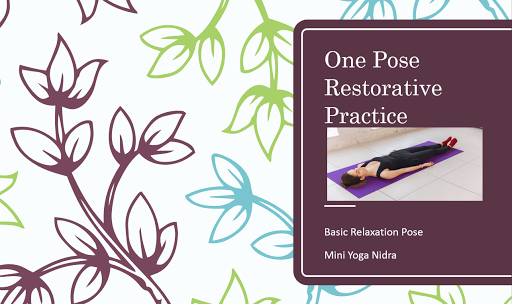
Making the most of every opportunity to rest and recover is critical to your health and wellness, especially if you are a runner. It is during rest that your body is allowed to heal and adapt to the stress of running. And while sitting and lounging may seem like a good way to heal, research has shown it is not.[1] The best opportunity to heal from the stress of running may be found in restorative yoga.
Restorative yoga is a deeply relaxing style of yoga. It is a receptive practice, not an active practice. Thus, the focus of restorative yoga is not on strengthening or even on stretching, but on healing. During a restorative yoga practice, the effects of physiological and biochemical damage to body tissues, as well as the psychological reaction to that damage, are reversed in a significantly shorter time when compared with simply sitting.[2]
This is why restorative yoga is a fantastic choice during your rest or recovery days, and especially after every long run. The length of your restorative yoga practice should be relative to the strain of your running. A general rule of thumb is a minimum of 10 minutes of restorative yoga for every hour of running[3]. For example, if you have run 3 hours in a week, then take the opportunity to practice at least 30 minutes of restorative yoga.
However, a longer or more frequent restorative yoga practice may work better for you. Just be sure you are experiencing a sensation of comfort and relaxation in the poses, not deep stretching. Resting in supported, restorative poses provides an excellent opportunity for your body and mind to heal.
Rest & Recovery Practice[4] - approximately 30 minutes
Props: Bolster or firm cushion/pillow; blanket* Calming Breath: Transition between each pose with 3 Calming Breaths.

 3. Belly Down Twist: (2 - 5 minutes per side) - Releases tension in the hips, back, and chest.
 4. Simple Supported Backbend: (3-5 minutes) – Releases chest muscles.
 5. Supported Child’s Pose: (3-5 minutes) - Releases tension in your back, thighs, and ankles
 6. Legs Up the Wall: (7 – 15 minutes) - Drains swelling from
your legs while relaxing your pelvis and back.
6. Legs Up the Wall: (7 – 15 minutes) - Drains swelling from
your legs while relaxing your pelvis and back.
[1] Bera TK, Gore MM, Oak JP. Recovery from stress in two different postures and in Shavasana--a yogic relaxation posture. Indian J Physiol Pharmacol. 1998;42(4):473-478.
[2] Boyle CA, Sayers SP, Jensen BE, Headley SA, Manos TM. The effects of yoga training and a single bout of yoga on delayed onset muscle soreness in the lower extremity. J Strength Cond Res. 2004;18(4):723-729. doi:10.1519/14723.1
[3] Rountree, S. H. The athlete's guide to recovery: Rest, relax, and restore for peak performance. VeloPress, 2011.
[4] Rountree, Sage Hamilton. The Runner's Guide to Yoga: a Practical Approach to Building Strength & Flexibility for Better Running. Velo Press, 2012.
Inhale –slowly through your nose, allow your diaphragm to fully expand
Exhale – slowly through your mouth, allow your belly to sink back towards your spine.
Exhale – slowly through your mouth, allow your belly to sink back towards your spine.

1. Supported Squat: (2-5 minutes) - Releases tension in back and legs.
*Squat on a bolster.
 2. Seated Supported Forward Fold: (3-5 minutes) - Gentle release of the hamstrings, helps to counteract tightness.

*Place a bolster across your extended legs, toes facing forward. Release forward from the pelvis (not the waist). Rest your head on folded arms or on the bolster.

*Sit with the short end of the bolster next to your right hip. Place a folded blanket between your bent legs. Turn to face the bolster, arms framing the bolster, and lower your belly down onto the bolster. Your head faces whatever direction feels most comfortable for you.

*Line the bolster up vertically behind you, then gently lie back over it. Place your arms in any position that is comfortable for you.

*Kneel with your knees on either side of the bolster. Then release your belly down onto the bolster. Rest on your forehead on the bolster or turn from one cheek to other halfway through the pose.

*Sit, with knees bent, and one hip very close to the wall. Slide the opposite arm away from the wall so that you are lying on your side. As you roll to recline on to your back, swivel your legs up the wall. Scoot towards or away from the wall for comfort. You may want to strap your legs together to keep them from sliding. Place your arms in any position that is comfortable for you.
[1] Bera TK, Gore MM, Oak JP. Recovery from stress in two different postures and in Shavasana--a yogic relaxation posture. Indian J Physiol Pharmacol. 1998;42(4):473-478.
[2] Boyle CA, Sayers SP, Jensen BE, Headley SA, Manos TM. The effects of yoga training and a single bout of yoga on delayed onset muscle soreness in the lower extremity. J Strength Cond Res. 2004;18(4):723-729. doi:10.1519/14723.1
[3] Rountree, S. H. The athlete's guide to recovery: Rest, relax, and restore for peak performance. VeloPress, 2011.
[4] Rountree, Sage Hamilton. The Runner's Guide to Yoga: a Practical Approach to Building Strength & Flexibility for Better Running. Velo Press, 2012.